
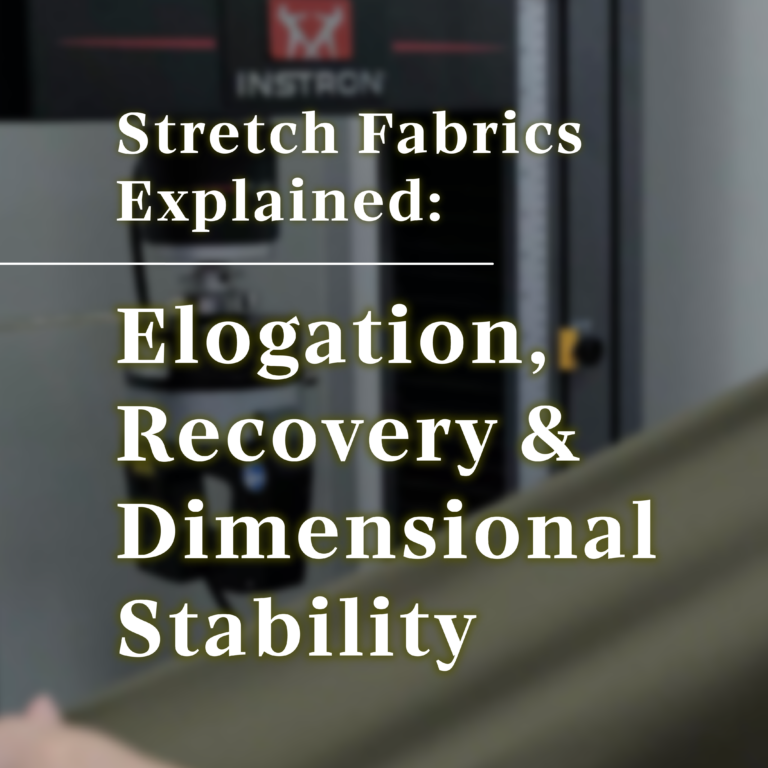
Stretch fabrics are everywhere — but how far they stretch, how fast they recover, and how well they hold shape are what really define performance.
For new designers, understanding these three key properties helps connect design intent with production reality.
1|Elongation — How Far Can It Stretch?
Elongation describes how much a fabric can stretch when a force is applied.
It’s usually expressed as a percentage increase over the original length:
Elongation (%) = (Length after stretch – Original length) ÷ Original length × 100%
This value helps designers and engineers discuss mobility and fabric behavior during movement — without limiting design possibilities.
Common Standards
- 🇺🇸 ASTM D5034 / D3107 – Tensile and extension for woven stretch fabrics
- 🇪🇺 ISO 13934-1 – Fabric extension under specified load
Interpretation Tips
- Moderate elongation → stable fit and appearance
- Excessive elongation → risk of deformation
- Low elongation → restricted movement or breakage risk
2|Recovery — How Fast Does It Bounce Back?
After stretching, recovery measures how well a fabric returns to its original dimension.
It is also expressed as a percentage, calculated as:
Recovery (%) = (Length after stretch – Length after recovery) ÷ (Length after stretch – Original length) × 100%
A fabric with good recovery keeps its silhouette and fit even after repeated motion or washing.
Common Standards
- 🇺🇸 ASTM D3107 – Stretch and recovery for woven fabrics
- 🇪🇺 ISO 13934-1 – Cyclic extension and recovery
Key Insights
- Consistent recovery keeps garment structure stable
- Incomplete recovery causes bagging or sagging
- Over-tight recovery may affect comfort
3|Dimensional Stability — Will It Shrink or Stay the Same?
Dimensional stability checks how much the fabric changes size after washing or heat exposure.
The change is expressed as a percentage:
Dimensional Change (%) = (Original dimension – After wash dimension) ÷ Original dimension × 100%
Positive values indicate shrinkage, negative values indicate growth or stretching.
Common Standards
- 🇺🇸 AATCC 135 / ASTM D3774 – Dimensional change after home laundering
- 🇪🇺 ISO 6330 – Washing and dimensional change methods
Stable fabrics ensure consistent fit and pattern control, especially for multi-panel garments or bonded constructions.
Why These Tests Matter for Design Teams
For design teams, these tests bridge the gap between creative design and manufacturing reality.
At Sunny, we can apply both ASTM/AATCC (U.S.) and ISO (Europe) testing standards to validate every fabric before it reaches sampling.
By monitoring elongation, recovery, and dimensional stability, we ensure that our stretch fabrics deliver consistent performance — from the first fitting to the hundredth wear.
This is how we define reliability — not just stretch.
✅ Key Test Reference
Property | U.S. Standard | EU Standard |
Elongation | ASTM D5034 / D3107 | ISO 13934-1 |
Recovery | ASTM D3107 | ISO 13934-1 |
Dimensional Stability | AATCC 135 / ASTM D3774 | ISO 6330 |
You may also like